
Ear conditions
Prominent ears in newborns
A prominent ear stands out from the side of the head more than is typical. Parents often describe it as an ear that “sticks out.” It can affect one or both ears and is one of the most common ear shapes we evaluate.
Medically reviewed by Dr. Steve Byrd, MD on
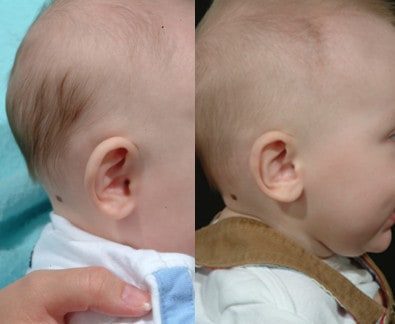
What a prominent ear looks like
Seen from the front or back, the ear angles away from the head. This usually happens because the curved fold inside the rim (the antihelix) is less defined than usual, because the bowl of the ear (the concha) is deep, or both. The ear itself is usually normal in size.
How it is assessed
The clinician looks at the angle of the ear, the antihelical fold and the depth of the concha, and checks for related features such as a conchal crus. Both ears are compared, since one may be more prominent than the other.
Is molding considered for prominent ears?
It may be. Molding can support a better-defined antihelical fold and hold the ear closer to the head while the cartilage is soft. The response depends on the cause of the prominence and your baby’s age. When to start.
A note on “cup ear”
This page used to be titled “Prominent ear or cup ear.” The terms are related but not the same. A prominent ear has normal-sized tissue that stands out. A cup ear usually describes a smaller ear with a tight, cupped upper rim, which clinicians group with constricted ears. Some babies have features of both. The clinician will tell you which describes your baby’s ear.
Questions about prominent ears
What makes a newborn’s ear stick out?
Usually a less-defined antihelical fold, a deep ear bowl (concha), or both. The ear is often normal in size but angled away from the head.
How are prominent ears assessed?
A clinician examines the ear’s angle, folds and cartilage and compares both ears. This also helps rule in or out related shapes such as a constricted ear.
Can molding help prominent ears?
Molding may be considered while the cartilage is soft. The clinician will explain what to expect for your baby. Candidacy.
Is a prominent ear the same as a cup ear?
No. A prominent ear stands out but is usually normal in size. A cup ear typically has a tight, cupped upper rim and is grouped with constricted ears. Constricted ear.
What are the options if my child is older?
Molding is used in infancy. For older children, families sometimes discuss otoplasty with a surgeon. Ear molding vs. otoplasty.
Questions about your baby’s ears?
Request an evaluation with EarWell Centers or call our team. We will help you understand the next step.